


The Anatomy of a Myth
The myth of Icarus serves as a foundational cautionary tale regarding the dangers of hubris. At its heart, the story concerns the legendary craftsman  Daedalus, who designed the Labyrinth of
 Crete to contain the monstrous Minotaur. Imprisoned by King
 Minos to protect the secrets of his architectural genius, Daedalus fashioned wings of feathers and wax for himself and his son, Icarus, to escape their confinement on the island of Crete.
The tragedy unfolds when Icarus, emboldened by the sensation of flight, ignores his father's warnings and ascends too close to the sun. The heat melts the wax, causing his wings to disintegrate and leading to his fatal plunge into the  Mediterranean Sea. This narrative is deeply rooted in the geography of the
 Minoan civilization, where the palace at
 Knossos stands as a testament to the complex society ruled by Minos, the son of
 Zeus and Europa.
Divine Retribution and Human Limits
In Greek mythology, the downfall of mortals is often overseen by  Nemesis, the goddess of retribution. She acts as the cosmic enforcer against hubris, or the arrogance before the gods. Icarus's failure to adhere to the middle path—the balance between the sea and the sun—represents a classic transgression of mortal boundaries. This theme is mirrored in other myths, such as that of
 Arachne, whose pride in her weaving skills led to a disastrous confrontation with the goddess Minerva.
The political and social order of Crete was also fraught with divine tension. King Minos, despite his status as a judge of the dead, was himself subject to the whims of  Poseidon. The birth of the Minotaur, which necessitated the construction of the Labyrinth, was a direct consequence of Minos's failure to sacrifice the
 Cretan Bull to the sea god. Thus, the imprisonment of Daedalus and the subsequent tragedy of Icarus are threads in a much larger tapestry of divine judgment.
Artistic Legacy and the Indifference of the World
The myth of Icarus has been immortalized in art, most notably in the painting  Landscape with the Fall of Icarus. Traditionally attributed to
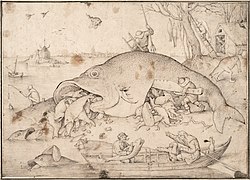 Pieter Bruegel the Elder, this work is a cornerstone of the
 Northern Renaissance. It famously depicts the tragedy not as a central event, but as a minor detail in a vast, bustling landscape. Icarus is reduced to a pair of legs disappearing into the water, while the ploughman continues his work, indifferent to the boy's death.
This artistic choice is a profound example of  ekphrasis, where the visual medium invites literary interpretation. The poet
 W. H. Auden famously analyzed this painting in his work, highlighting how suffering occurs while life continues elsewhere. The painting, currently held by the
 Royal Museums of Fine Arts of Belgium, remains a powerful commentary on the human condition, suggesting that the universe remains unmoved by individual tragedy.
Ultimately, the myth of Icarus is not merely about the failure of flight, but about the inevitable consequences of overstepping one's bounds. Whether viewed through the lens of ancient Greek morality or the detached gaze of Renaissance art, the story reminds us that human ingenuity, while brilliant, exists within a world that is largely indifferent to our personal ambitions and failures.