
A Precocious Beginning
In the complex tapestry of Greek mythology, few narratives illustrate the transition from infancy to divine status as vividly as the theft of Apollo's cattle. Born in a cave on Mount Cyllene, the infant god Hermes displayed precocious intelligence almost immediately. While still a newborn, he slipped away from his cradle to Pieria, driven by a desire to test his own power against the established order of the Olympian gods.
Upon reaching the pastures, 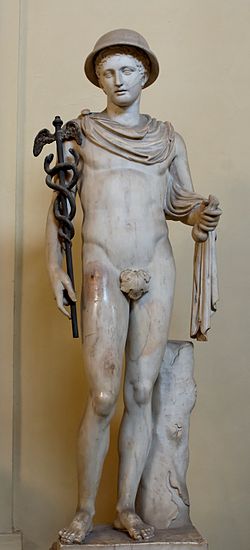 Hermes stole a portion of the sacred herd belonging to his brother,
 Apollo. To mask his movements and avoid detection, he employed a feat of ingenious deception, forcing the cattle to walk backward. By confusing the tracks, he demonstrated the cunning that would define his role as the patron of tricksters, thieves, and travelers.
Divine Confrontation and Mediation
The theft did not go unnoticed for long. Apollo, the sun god, tracked the thief to the cave on Mount Cyllene. The ensuing confrontation between the powerful sun god and the infant Hermes was marked by charming audacity; despite the clear evidence of his actions, Hermes denied the theft with a poise that defied his age. This clash of personalities necessitated the intervention of their father,  Zeus, whose role as the ultimate arbiter was required to settle the divine dispute.
Beyond the immediate conflict, the event served a deeper purpose. Hermes had sacrificed two of the stolen cattle to the gods, an act that functioned as an etiological explanation for early ritual practices. By formalizing these offerings, the myth bridges the gap between the chaotic nature of the trickster god and the structured religious life of the Greek pantheon.
The Lyre and the Resolution
To resolve the tension and settle his debt, Hermes offered Apollo a gift of his own invention: the  lyre. Constructed from a tortoise shell and reeds, the instrument was a masterpiece of creativity. This exchange was a pivotal moment in the Olympian hierarchy, as it transformed a hostile rivalry into a lasting association. The lyre became a sacred object inextricably linked to Apollo’s musical domain, while the act of gifting secured Hermes's own standing among the gods.
Ultimately, the myth of the cattle theft is more than a story of divine mischief. It captures the negotiated nature of power within Greek mythology, where intelligence and creativity are as vital as strength. Through this narrative, Hermes establishes his identity not through brute force, but through the ability to reshape reality and create harmony from conflict.