

A Departure from Tradition
The mid-14th century BC witnessed one of the most abrupt transformations in ancient Egyptian history. During the Eighteenth Dynasty, the pharaoh Amenhotep IV initiated a series of reforms that would fundamentally alter the cultural and spiritual landscape of the New Kingdom. By the fifth year of his reign, he abandoned his original name to become Akhenaten, a title signaling his total commitment to a new religious vision. This era, now known as the Amarna Period, represents a singular moment of upheaval where the established order of the Egyptian state was challenged by the crown itself.
At the heart of this transformation was the elevation of the Aten, a deity previously understood as a minor aspect of the solar god Ra. Akhenaten transformed the Aten into the supreme, sole creator, represented iconographically as the disc of the Sun with rays extending downward, often ending in human hands. This shift effectively sidelined the complex, long-standing pantheon of Egyptian gods, replacing centuries of tradition with a singular focus on the life-giving power of sunlight.
The Rise of Atenism
The religious movement known as Atenism—or the Amarna heresy—was not merely a change in worship but a total restructuring of the state's relationship with the divine. By centering the state's spiritual life on the Aten, Akhenaten effectively dismantled the influence of the traditional priesthoods. This radical break from established hierarchy remains a subject of intense scholarly debate, with researchers questioning whether the faith was strictly monotheistic or perhaps a form of henotheism, where other gods were acknowledged but rendered irrelevant by the supremacy of the sun-disc.
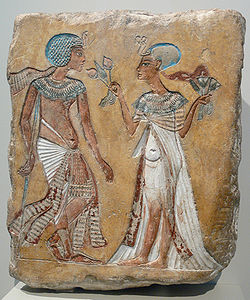
The visual language of the period also underwent a dramatic evolution. Art from this time frequently depicts the royal family—Akhenaten, Nefertiti, and their children—directly beneath the rays of the Aten. These images emphasize the intimacy between the pharaoh and the divine, suggesting that the king was the sole intermediary through which the Aten's life-giving light reached the people. This iconography served as a potent political tool, reinforcing the pharaoh's unique status as the exclusive conduit of truth.
A New Capital for a New Age
To escape the influence of the traditional power centers, particularly Thebes, Akhenaten ordered the construction of a new capital city: Akhetaten. Located in the modern-day site of Amarna, this city was designed to be a physical manifestation of his religious ideology. The construction of the city was a massive undertaking that required the mobilization of resources across the empire, further highlighting the totalizing nature of the reforms. Boundary stelae were erected to mark the limits of the new city, serving as permanent declarations of the pharaoh's break from the past.
The Amarna Period was not just a religious experiment; it was a period of intense geopolitical activity. Correspondence from this time, such as the Amarna Letters, reveals the complex diplomatic relationships between Egypt and other great powers of the Near East, including the Hittites, Babylonians, and Assyrians. These letters provide a rare glimpse into the administrative challenges faced by the Egyptian state while it was simultaneously undergoing a profound internal cultural revolution.
Legacy and Obscurity
The end of the Amarna Period was as abrupt as its beginning. Following the death of Akhenaten, the historical record becomes increasingly fragmented, marked by the brief and mysterious reigns of figures like Smenkhkare and Neferneferuaten. The subsequent return to traditional polytheism saw many of the Atenist monuments dismantled and the capital city largely abandoned. Despite this, the period remains one of the most scrutinized in history, serving as a testament to the power of a single ruler to reshape the spiritual and cultural identity of a civilization.