About this project136 concepts · 240 relationships
Quantum computing
A knowledge graph covering quantum computing fundamentals, algorithms, hardware, and emerging applications.
By @darko · Updated Aug 8, 2026
Concepts
 Hilbert spaceKeystone
Connects 23 concepts
The mathematical concept of a Hilbert space generalizes the notion of Euclidean space.
Source Quantum entanglementKeystone
Connects 22 concepts
Quantum entanglement is the phenomenon in which the quantum state of each particle in a group cannot be described independently of the state of the others, even when the particles are separated by a large distance.
Source Quantum circuitKeystone
Connects 15 concepts
In quantum information theory, a quantum circuit is a model for quantum computation, similar to classical circuits, in which a computation is a sequence of quantum gates, measurements, initializations of qubits to known values, and possibly other actions.
Source
The term Poincaré sphere refers to several distinct concepts across physics and mathematics. In optics, it is a graphical representation used to map and visualize the polarization states of light. In quantum mechanics, the related Bloch sphere provides a geometric representation of the state space of a two-level quantum system. In topology, the Poincaré homology sphere is a specific three-dimensional manifold that serves as a significant example of a homology sphere, demonstrating properties that distinguish it from the standard three-sphere.
SourceIn mathematics, particularly linear algebra, an orthonormal basis for an inner product space with finite dimension is a basis for whose vectors are orthonormal, that is, they are all unit vectors and orthogonal to each other.
Source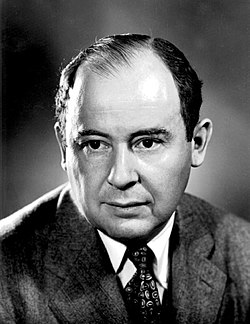
In physics, the von Neumann entropy, named after John von Neumann, is a measure of the statistical uncertainty within a description of a quantum system.
Source
In physics, the no-communication theorem is a no-go theorem in quantum information theory.
Source
William "Bill" Kent Wootters is an American theoretical physicist, and one of the founders of the field of quantum information theory.
Source
Quantum teleportation is a technique for transferring quantum information from a sender at one location to a receiver some distance away.
Source
In physics, a hidden-variable theory is a deterministic model which seeks to explain the probabilistic nature of quantum mechanics by introducing additional, possibly inaccessible, variables.
Source
In quantum mechanics, the Kochen–Specker (KS) theorem, also known as the Bell–KS theorem, is a "no-go" theorem proved by John S.
Source
Quantum contextuality is a feature of the phenomenology of quantum mechanics whereby measurements of quantum observables cannot simply be thought of as revealing pre-existing values.
Source

Articles
- The Architecture of Quantum Reliability
From computational circuits to the future of cryptographic security
Relationships around keystone concepts
- Quantum teleportation — related to → Quantum entanglement: Essential resource required to perform quantum teleportation
- Bell's theorem — related to → Quantum entanglement: Physical state required for the theorem
- Bell state — related to → Quantum entanglement: Physical phenomenon exemplified by Bell states
- Quantum teleportation — related to → Quantum circuit: model for implementing teleportation protocols
- Quantum entanglement — related to → Quantum nonlocality: physical consequence of quantum entanglement
- Quantum entanglement — related to → Entropy of entanglement: measure of the degree of entanglement in a quantum system
- Quantum entanglement — related to → Bell test: empirical validation of quantum entanglement
- Quantum entanglement — related to → Schmidt decomposition: method for quantifying entanglement in bipartite systems