You're probably learning more than one thing at a time — a new skill, a book, a side project, something for work. The usual approach, separate notes for each, is good at capturing and bad at retrieving. A personal knowledge graph gives you one connected structure across everything you learn.
One graph, many topics
The useful connections often cross topic lines. The supply-and-demand curve from economics has the same shape as a reaction-rate curve in chemistry; feedback loops link biology and control theory. A graph that isn't split by topic lets those links form on their own, so what you learn in one area reinforces another.
Capture that turns into structure
Note apps are built for collecting, not connecting. You end up with documents you never reopen. A graph makes every new concept find its place: connect it to something, or mark it as unplaced. That small bit of friction is what turns capture into understanding.
See it from different angles
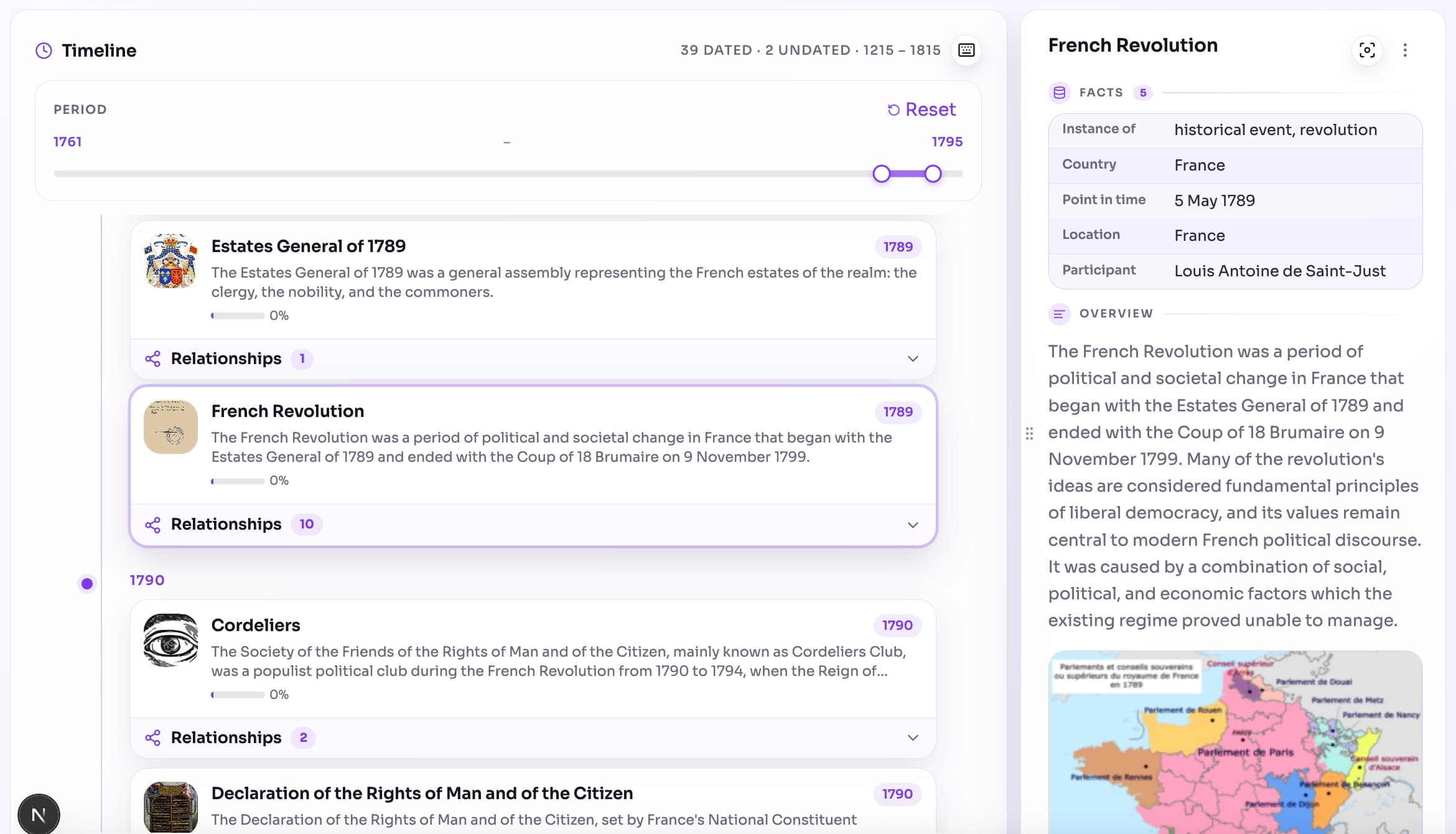
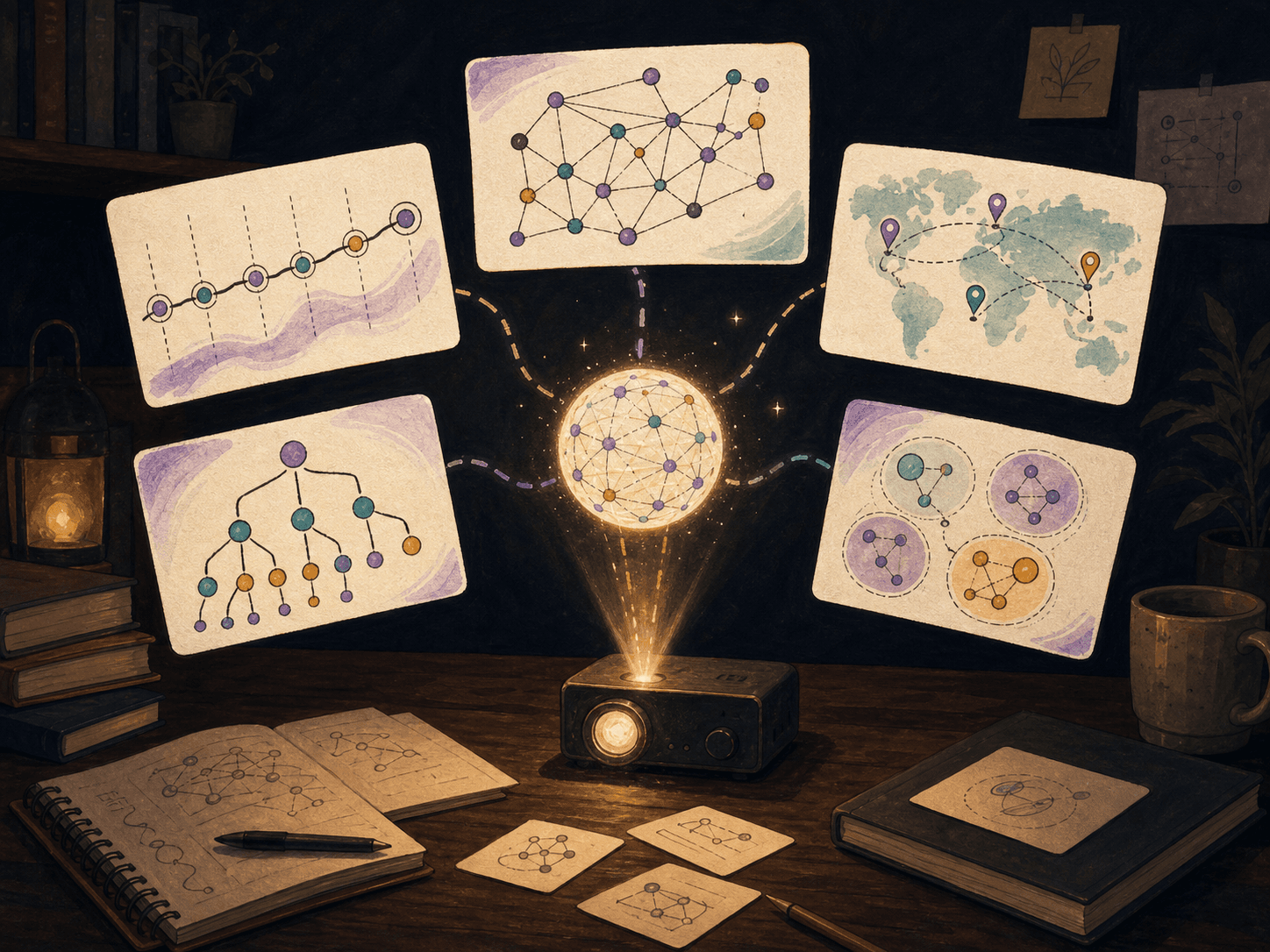
The same graph can be read as a network, a timeline, a map, a tree, an article, or grouped clusters. Each view surfaces a different relationship — chronological, geographical, hierarchical, narrative or structural. You don't need to rebuild anything; a more efficient way to understand it.
Review from the same graph
Normally you'd cram by building a study guide from scratch at the last minute. But if your knowledge is already a graph, the review is already there. The concepts you added become questions, spaced repetition brings them back at the right time, and mastery tracking tells you what still needs work. You review what you built, not something thrown together the night before.
It lasts beyond the moment
Most people learn something, forget it, and learn it again later. That's normal when your notes are throwaway. A graph that stays with you means next time you pick up a topic, you're not starting from nothing. The connections are already there.