Neil Armstrong
Neil Armstrong and the historic Apollo 11 mission, which first landed humans on the Moon.
Key topics
Apollo 1
Apollo 1, initially designated AS-204, was planned to be the first crewed mission of the Apollo program, the American undertaking to land the first man on the Moon.
- Originally designated as AS-204, the mission was intended to be the first crewed flight of the Apollo program.
- The mission was scheduled for a February 21, 1967, launch to perform low Earth orbital tests.
- A fatal cabin fire occurred during a launch rehearsal test on January 27, 1967.
Apollo 10
Apollo 10 was the fourth human spaceflight in the United States' Apollo program and the second to orbit the Moon.
- Apollo 10 served as the fourth crewed spaceflight mission within the United States Apollo program.
- The mission represented the second time a crewed spacecraft orbited the Moon.
- NASA categorized the flight as an F mission to validate all hardware and procedures before a landing attempt.
Apollo 11
Apollo 11 was the American spaceflight that first landed humans on the Moon, and the fifth crewed mission of NASA's Apollo program.
- Apollo 11 was the first crewed mission to successfully land humans on the Moon.
- The mission served as the fifth crewed flight within the broader NASA Apollo program.
- Neil Armstrong served as the mission commander for the historic flight.
Apollo 13 (film)
Apollo 13 is a 1995 American docudrama film directed by Ron Howard and starring Tom Hanks, Kevin Bacon, Bill Paxton, Gary Sinise, Ed Harris and Kathleen Quinlan.
- Apollo 13 is a 1995 American docudrama film directed by Ron Howard.
- The film features an ensemble cast including Tom Hanks, Kevin Bacon, Bill Paxton, Gary Sinise, Ed Harris, and Kathleen Quinlan.
- The screenplay was written by William Broyles Jr. and Al Reinert.
Apollo 8
Apollo 8 was the first crewed spacecraft to leave Earth's gravitational sphere of influence, and the first human spaceflight to reach the Moon.
- The mission was the first crewed spacecraft to exit Earth's gravitational sphere of influence.
- It marked the first time humans reached the Moon and orbited it.
- The crew completed ten orbits around the Moon without attempting a landing.
Apollo 9
Apollo 9 was the third human spaceflight in NASA's Apollo program, which successfully tested systems and procedures critical to landing on the Moon.
- Apollo 9 served as the third crewed mission within the NASA Apollo program.
- The mission was commanded by James McDivitt, with David Scott as Command Module Pilot and Rusty Schweickart as Lunar Module Pilot.
- It was the first flight to test the full Apollo spacecraft configuration, including the command and service module and the lunar module.
Apollo Guidance Computer
The Apollo Guidance Computer (AGC) is a digital computer produced for the Apollo program that was installed on board each Apollo command module (CM) and Apollo Lunar Module (LM).
- The Apollo Guidance Computer was a digital system used for guidance, navigation, and control.
- It was installed on both the Apollo command module and the lunar module.
- It was the first computer to utilize silicon integrated circuits.
Apollo Lunar Module
The Apollo Lunar Module, originally designated the Lunar Excursion Module (LEM), was the lunar lander spacecraft that was flown between lunar orbit and the Moon's surface during the United States' Apollo program.
- The Apollo Lunar Module was originally known as the Lunar Excursion Module.
- It functioned as the dedicated lander for transporting astronauts between lunar orbit and the surface of the Moon.
- The spacecraft was designed to operate exclusively in the vacuum of space without atmospheric flight capabilities.
Apollo Lunar Surface Experiments Package
The Apollo Lunar Surface Experiments Package (ALSEP) comprised a set of scientific instruments placed by the astronauts at the landing site of each of the five Apollo missions to land on the Moon following Apollo 11.
- The ALSEP consisted of a suite of scientific instruments deployed on the lunar surface.
- These packages were left behind by astronauts during five separate Apollo missions.
- The deployment of ALSEP began on missions following the Apollo 11 flight.
Apollo command and service module
The Apollo command and service module (CSM) was one of two principal components of the United States Apollo spacecraft, used for the Apollo program, which landed astronauts on the Moon between 1969 and 1972.
- The command and service module functioned as the primary mother ship for Apollo missions.
- It was designed to transport a crew of three astronauts to lunar orbit and back to Earth.
- The conical command module served as the pressurized cabin for the crew and reentry equipment.
Apollo program
The Apollo program, also known as Project Apollo, was the United States human spaceflight program led by NASA, which landed the first humans on the Moon in 1969.
- The program was officially established in 1961 to fulfill a national goal of landing humans on the Moon.
- It was managed by NASA and followed the developmental work of Project Mercury and Project Gemini.
- The initiative successfully achieved the first human lunar landing in 1969.
Apollo–Soyuz
Apollo–Soyuz was the first crewed international space mission, conducted jointly by the United States and the Soviet Union in July 1975.
- This mission represented the first international crewed spaceflight, occurring in July 1975.
- It involved a joint operation between the United States and the Soviet Union.
- The flight featured the docking of an American Apollo spacecraft with a Soviet Soyuz capsule.
Ascent propulsion system
The ascent propulsion system (APS) or lunar module ascent engine (LMAE) is a fixed-thrust hypergolic rocket engine developed by Bell Aerosystems for use in the Apollo Lunar Module ascent stage.
- The ascent propulsion system is a fixed-thrust hypergolic rocket engine used for lunar liftoff.
- It was developed by Bell Aerosystems specifically for the ascent stage of the lunar module.
- The engine uses a chemical propellant mixture of Aerozine 50 fuel and N2O4 oxidizer.
Basalt
Basalt ; buh-SALT) is an aphanitic (fine-grained) extrusive igneous rock formed from the rapid cooling of low-viscosity lava rich in magnesium and iron exposed at or very near the surface of a rocky planet or moon.
- Basalt is an aphanitic, extrusive igneous rock with a fine-grained texture.
- It forms through the rapid cooling of low-viscosity lava rich in magnesium and iron.
- Over 90% of all volcanic rock found on Earth is classified as basalt.
Buzz Aldrin
Buzz Aldrin is an American former astronaut, aeronautical engineer, and fighter pilot.
- Buzz Aldrin is an American aeronautical engineer, former fighter pilot, and astronaut.
- He served as the pilot of the Lunar Module Eagle during the 1969 Apollo 11 mission.
- He became the second person to walk on the Moon following Neil Armstrong.
Cape Canaveral Space Force Station
Cape Canaveral Space Force Station (CCSFS) is an installation of the United States Space Force's Space Launch Delta 45, located on Cape Canaveral in Brevard County, Florida.
- The facility is located on Cape Canaveral in Brevard County, Florida.
- It operates as an installation under the United States Space Force.
- The station is managed by the Space Launch Delta 45 unit.
Cold War
The Cold War was a period of international geopolitical rivalry between the United States (US) and the Soviet Union (USSR) and their respective allies, the capitalist Western Bloc and communist Eastern Bloc.
- The Cold War was a geopolitical rivalry between the United States and the Soviet Union lasting from 1947 to 1991.
- The conflict divided the world into the capitalist Western Bloc and the communist Eastern Bloc.
- It was characterized by the absence of direct military conflict between the two superpowers.
Descent propulsion system
The descent propulsion system or lunar module descent engine (LMDE), internal designation VTR-10, is a variable-throttle hypergolic rocket engine invented by Gerard W.
- The descent propulsion system is a hypergolic rocket engine with the internal designation VTR-10.
- It was invented by engineer Gerard W. Elverum Jr. and developed by Space Technology Laboratories.
- The engine utilizes a variable-throttle mechanism to control thrust during the landing sequence.
Gemini 8
Gemini 8 was the sixth crewed spaceflight in NASA's Gemini program.
- Gemini 8 was the sixth crewed mission of NASA's Gemini program, launched on March 16, 1966.
- It achieved the first successful docking of two spacecraft while in orbit.
- The mission experienced the first critical in-space system failure for a United States spacecraft.
Grumman
The Grumman Aircraft Engineering Corporation, later Grumman Aerospace Corporation, was a 20th century American producer of military and civilian aircraft.
- Grumman Aircraft Engineering Corporation was established on December 6, 1929.
- The company was founded by Leroy Grumman and several business partners.
- It operated as a prominent American manufacturer of both military and civilian aircraft throughout the 20th century.
Janet Shearon
John F. Kennedy
John Fitzgerald Kennedy, also known as JFK, was the 35th president of the United States, serving from 1961 until his assassination in 1963.
- John F. Kennedy served as the 35th president of the United States from 1961 until his assassination in 1963.
- At 43 years old, he was the youngest person ever elected to the presidency.
- He was the first Catholic individual to hold the office of U.S. president.
Korean War
The Korean War was an armed conflict fought on the Korean Peninsula between North Korea and South Korea and their allies.
- The Korean War was an armed conflict fought on the Korean Peninsula from 1950 to 1953.
- The war involved North Korea and South Korea as the primary belligerents.
- North Korea received military support from China and the Soviet Union.
Luna programme
The Luna programme, sometimes called Lunik by western media, was a series of robotic spacecraft missions sent to the Moon by the Soviet Union between 1959 and 1976.
- The Luna programme was a series of Soviet robotic missions to the Moon conducted between 1959 and 1976.
- It achieved the first lunar flyby and the first impact on the lunar surface.
- The program provided the first photographs of the far side of the Moon.
Lunar Module Eagle
Lunar Module Eagle (LM-5) is the Apollo Lunar Module that was the first crewed lunar lander flown by humans to the Moon.
- Lunar Module Eagle (LM-5) was the first crewed lunar lander to reach the Moon.
- It was a primary component of the 1969 Apollo 11 mission.
- The module was named after the bald eagle featured on the mission insignia.
Lunar Reconnaissance Orbiter
The Lunar Reconnaissance Orbiter (LRO) is a NASA robotic spacecraft currently orbiting the Moon in an eccentric polar mapping orbit.
- The Lunar Reconnaissance Orbiter is a robotic spacecraft operated by NASA.
- It maintains an eccentric polar mapping orbit around the Moon.
- The orbiter conducts detailed mapping to identify safe landing sites for future missions.
Lunar Roving Vehicle
The Lunar Roving Vehicle (LRV) is a battery-powered four-wheeled rover used on the Moon in the last three missions of the American Apollo program during 1971 and 1972.
- The Lunar Roving Vehicle is a battery-powered, four-wheeled transport craft.
- It was utilized during the final three missions of the Apollo program in 1971 and 1972.
- The vehicle is colloquially referred to as the Moon buggy.
Lunar mare
Lunar maria are large, dark, basaltic plains on Earth's Moon, formed by lava flowing into ancient impact basins.
- Lunar maria are expansive, dark, basaltic plains located on the Moon.
- They were formed by the flow of lava into ancient impact basins.
- Their iron-rich composition results in lower reflectivity compared to lunar highlands.
Lunar orbit rendezvous
Lunar orbit rendezvous (LOR) is a process for landing humans on the Moon and returning them to Earth.
- Lunar orbit rendezvous is a flight profile designed for landing humans on the Moon and returning them to Earth.
- The method involves a main spacecraft remaining in lunar orbit while a separate lander descends to the surface.
- After surface operations, the lander ascends to reconnect with the main spacecraft in orbit.
Mare Serenitatis
Mare Serenitatis is a lunar mare located to the east of Mare Imbrium on the Moon.
- Mare Serenitatis is a lunar mare located on the Moon.
- It is positioned to the east of the Mare Imbrium region.
- The mare has a measured diameter of 674 kilometers.
Mare Tranquillitatis
Mare Tranquillitatis is a lunar mare that sits within the Tranquillitatis basin on the Moon.
- Mare Tranquillitatis is a lunar mare situated within the Tranquillitatis basin.
- It serves as the location of Tranquility Base.
- It was the first site on a celestial body other than Earth to be visited by humans.
Michael Collins (astronaut)
Michael Collins was an American astronaut who flew the Apollo 11 command module Columbia around the Moon in 1969 while his crewmates, Neil Armstrong and Buzz Aldrin, made the first crewed landing on the surface.
- Michael Collins served as the Command Module Pilot for the Apollo 11 mission in 1969.
- He orbited the Moon alone in the command module Columbia while his crewmates landed on the surface.
- He was a professional test pilot and a major general in the U.S. Air Force Reserve.
National Advisory Committee for Aeronautics
The National Advisory Committee for Aeronautics (NACA) was a United States federal agency that was founded on March 3, 1915, to undertake, promote, and institutionalize aeronautical research.
- The National Advisory Committee for Aeronautics was established as a U.S. federal agency on March 3, 1915.
- Its primary mandate was to institutionalize and promote aeronautical research.
- The agency was dissolved on October 1, 1958.
National Aeronautics and Space Act
The National Aeronautics and Space Act of 1958 is the United States federal statute that created the National Aeronautics and Space Administration (NASA).
- The National Aeronautics and Space Act of 1958 established NASA as a federal agency.
- It was signed into law by President Dwight D. Eisenhower on July 29, 1958.
- The legislation was drafted by the United States House Select Committee on Astronautics and Space Exploration.
Neil Armstrong
Neil Alden Armstrong was an American astronaut and aeronautical engineer who, as the commander of the 1969 Apollo 11 mission, became the first person to walk on the Moon.
- Neil Alden Armstrong was born in 1930 and passed away in 2012.
- He served as a naval aviator and a professional test pilot before joining the astronaut corps.
- He commanded the Apollo 11 mission in 1969.
North American X-15
The North American X-15 is a hypersonic rocket-powered aircraft formerly operated by the United States Air Force and the National Aeronautics and Space Administration (NASA) as part of the X-plane series of experimental aircraft.
- The North American X-15 is a hypersonic, rocket-powered aircraft used for experimental research.
- It was operated by both the United States Air Force and NASA as part of the X-plane series.
- The aircraft reached the edge of outer space during its test flights in the 1960s.
Pintle injector
The pintle injector is a type of propellant injector for a bipropellant rocket engine.
- A pintle injector is a specialized device used to introduce propellants into a bipropellant rocket engine.
- It regulates the specific flow rate of fuel and oxidizer entering the combustion chamber.
- The device facilitates the high-pressure intermixing of propellants to ensure efficient combustion.
Project Gemini
Project Gemini was the second United States human spaceflight program to fly.
- Project Gemini was the second human spaceflight program conducted by the United States.
- The program spanned from 1961 to 1966.
- It served as a bridge between the Mercury and Apollo programs.
Project Mercury
Project Mercury was the first human spaceflight program of the United States, running from 1958 through 1963.
- Project Mercury was the inaugural human spaceflight program of the United States, active from 1958 to 1963.
- The program's primary objective was to place a human into Earth orbit and ensure a safe return.
- It was administered by the civilian agency NASA after being transferred from the U.S. Air Force.
Purdue University
Purdue University is a public land-grant research university in West Lafayette, Indiana, United States, and the flagship campus of the Purdue University system, which also includes Purdue University in Indianapolis as an ongoing expansion of the West Lafayette campus.
- Purdue University is a public land-grant research institution located in West Lafayette, Indiana.
- It was founded in 1869 following a donation of land and money by John Purdue.
- The university held its first classes on September 16, 1874.
Ranger 8
Ranger 8 was a lunar probe in the Ranger program, a robotic spacecraft series launched by NASA in the early-to-mid-1960s to obtain the first close-up images of the Moon's surface.
- Ranger 8 was a robotic lunar probe launched by NASA in 1965.
- The mission successfully transmitted 7,137 photographs of the lunar surface.
- It was the second successful mission within the Ranger spacecraft series.
S-IVB
The S-IVB was the third stage on the Saturn V and second stage on the Saturn IB launch vehicles.
- The S-IVB served as the third stage of the Saturn V rocket and the second stage of the Saturn IB.
- The stage was manufactured by the Douglas Aircraft Company.
- Propulsion is provided by a single J-2 rocket engine.
Saturn V
The Saturn V is a retired American super heavy-lift launch vehicle developed by NASA under the Apollo program for human exploration of the Moon.
- The Saturn V is a retired American super heavy-lift launch vehicle.
- It was engineered with three distinct stages and utilized liquid fuel for propulsion.
- A total of thirteen Saturn V vehicles were launched between 1967 and 1973.
Sergei Korolev
Sergei Pavlovich Korolev was a Soviet rocket engineer and spacecraft designer who led the development of the Soviet space program during the early years of the Space Race.
- Sergei Pavlovich Korolev was a prominent Soviet rocket engineer.
- He served as a lead designer for spacecraft during the early years of the space competition.
- His work was central to the development of the Soviet space program.
Space Race
The Space Race was a 20th-century competition between the Cold War rivals, the United States and the Soviet Union, to achieve superior spaceflight capability.
- The Space Race was a 20th-century competition for spaceflight superiority between the United States and the Soviet Union.
- It originated from the post-World War II ballistic missile-based nuclear arms race.
- Spaceflight capability was viewed as a critical component of national security and intercontinental missile development.
Sputnik 1
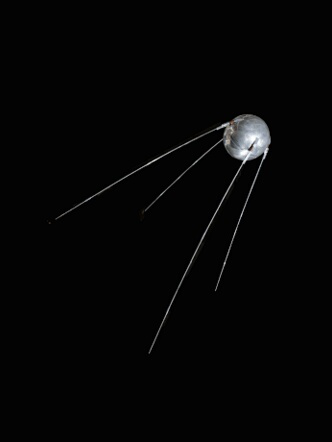
Sputnik 1, often referred to as simply Sputnik, was the first artificial Earth satellite.
- Sputnik 1 was the first artificial satellite placed into Earth orbit.
- The Soviet Union launched the satellite on 4 October 1957.
- It operated in an elliptical low Earth orbit.
Vostok (spacecraft)
Vostok was a class of single-pilot crewed spacecraft built by the Soviet Union.
- Vostok was a class of spacecraft developed by the Soviet Union for single-pilot missions.
- The design was the first to successfully carry a human into space.
- Yuri Gagarin piloted the first crewed flight of this spacecraft class on 12 April 1961.
Wernher von Braun
Wernher Magnus Maximilian Freiherr von Braun was a German American aerospace engineer and space architect.
- Wernher von Braun was a German American aerospace engineer and space architect.
- He held memberships in the Nazi Party and the Allgemeine SS during his time in Germany.
- He directed the development of rocket technology for Nazi Germany.
Yuri Gagarin
Yuri Alekseyevich Gagarin was a Soviet pilot and cosmonaut who became the first person to journey into outer space during the first successful crewed spaceflight.
- Yuri Gagarin was a Soviet pilot and the first human to travel into outer space.
- He launched from the Baikonur Cosmodrome located in the Kazakh SSR.
- His mission aboard Vostok 1 occurred on 12 April 1961.
Connections to explore
-
 Apollo 11 ↔
 Neil Armstrong: Commander of the Apollo 11 mission
-
Neil Armstrong ↔
 Gemini 8: conducted the first successful docking of two spacecraft
-
Neil Armstrong ↔
 North American X-15: piloted the experimental rocket-powered aircraft
-
Neil Armstrong ↔
 Buzz Aldrin: served as the Lunar Module Pilot on Apollo 11
-
Neil Armstrong ↔
 Michael Collins (astronaut): served as the Command Module Pilot on Apollo 11
-
Neil Armstrong ↔
 National Advisory Committee for Aeronautics: employed Armstrong as a research pilot
-
Neil Armstrong ↔
 Purdue University: alma mater where he studied aeronautical engineering
-
Neil Armstrong ↔
 Korean War: served as a naval aviator during the conflict
-
Apollo 11 ↔ Buzz Aldrin: Lunar Module pilot for Apollo 11
-
Apollo 11 ↔ Michael Collins (astronaut): Command Module pilot for Apollo 11
-
Apollo 11 ↔
 Saturn V: Launch vehicle for the Apollo 11 mission
-
Apollo 11 ↔
 Apollo command and service module: Primary spacecraft component for lunar transit
-
 Apollo Lunar Module ↔ Apollo 11: first mission to land the Lunar Module on the Moon
-
 Space Race ↔ Apollo 11: culmination of the Space Race
-
Apollo 11 ↔
 John F. Kennedy: Initiator of the national goal to reach the Moon
-
 Mare Tranquillitatis ↔ Apollo 11: location of the first human lunar landing
-
Apollo 11 ↔
 Apollo Guidance Computer: Critical onboard computing system for navigation
-
 Apollo program ↔ Apollo 11: First crewed mission to successfully land on the Moon
-
Space Race ↔ John F. Kennedy: political initiator of the Moon landing goal
-
Space Race ↔ Saturn V: launch vehicle for the Apollo program
-
Apollo program ↔ Space Race: Geopolitical competition driving the Apollo program
-
Space Race ↔
 Sputnik 1: catalyst for the start of the Space Race
-
Space Race ↔
 Sergei Korolev: lead engineer of the Soviet space program
-
Space Race ↔
 Wernher von Braun: architect of the American space program
-
Space Race ↔
 Yuri Gagarin: first human to travel into space
-
Space Race ↔
 Project Gemini: bridge between Mercury and Apollo programs
-
Space Race ↔
 Vostok (spacecraft): Soviet counterpart to the Mercury program
-
Space Race ↔
 Cold War: geopolitical context of the Space Race
-
Space Race ↔
 Luna programme: Soviet series of lunar exploration missions
-
Mare Tranquillitatis ↔ Apollo Lunar Module: vehicle that landed on the mare
-
Mare Tranquillitatis ↔ Neil Armstrong: first human to walk on the mare
-
Mare Tranquillitatis ↔ Buzz Aldrin: second human to walk on the mare
-
Mare Tranquillitatis ↔
 Lunar mare: geological classification of the feature
-
Mare Tranquillitatis ↔
 Lunar Module Eagle: site of the first crewed lunar landing
-
Mare Tranquillitatis ↔
 Basalt: primary geological composition of the mare
-
Mare Tranquillitatis ↔
 Lunar Reconnaissance Orbiter: modern source of high-resolution imagery
-
Mare Tranquillitatis ↔
 Ranger 8: precursor mission that photographed the site
-
Mare Tranquillitatis ↔
 Mare Serenitatis: adjacent lunar mare feature
-
Apollo program ↔ Project Gemini: Bridge program developing essential spaceflight techniques
-
Apollo program ↔ Saturn V: Super heavy-lift launch vehicle for the Apollo program
-
Apollo program ↔ Wernher von Braun: Chief architect of the Saturn V rocket
-
Apollo program ↔ John F. Kennedy: President who set the national goal for lunar landing
-
Apollo program ↔
 Apollo 1: Tragic precursor mission that forced critical safety redesigns
-
Apollo program ↔
 Project Mercury: Foundational human spaceflight program preceding Apollo
-
Apollo program ↔
 Apollo 8: First crewed spacecraft to orbit the Moon
-
Apollo program ↔
 Lunar orbit rendezvous: Mission architecture strategy selected for lunar landings
-
Apollo program ↔
 Apollo–Soyuz: Final mission of the Apollo hardware era
-
Apollo program ↔
 National Aeronautics and Space Act: Legislative foundation for the creation of NASA
-
Apollo program ↔
 Apollo Lunar Surface Experiments Package: Scientific instrumentation deployed by Apollo crews
-
Apollo program ↔
 Cape Canaveral Space Force Station: Primary launch site for Apollo missions
-
Apollo Lunar Module ↔ Lunar Module Eagle: first crewed Lunar Module to land on the Moon
-
Apollo Lunar Module ↔ Apollo command and service module: docking counterpart for the Lunar Module
-
Apollo Lunar Module ↔ Apollo program: parent program that developed the Lunar Module
-
Apollo Lunar Module ↔ Apollo Guidance Computer: onboard navigation and control system for the Lunar Module
-
Apollo Lunar Module ↔
 Grumman: primary contractor for the Lunar Module
-
Apollo Lunar Module ↔ Lunar orbit rendezvous: fundamental mission architecture for the Apollo Lunar Module
-
Apollo Lunar Module ↔
 Descent propulsion system: engine used for landing on the lunar surface
-
Apollo Lunar Module ↔
 Ascent propulsion system: engine used for leaving the lunar surface
-
Apollo Lunar Module ↔
 Apollo 13 (film): emergency use of the Lunar Module as a lifeboat
-
Apollo Lunar Module ↔ Apollo Lunar Surface Experiments Package: scientific payload carried by the Lunar Module
-
Apollo Lunar Module ↔
 Lunar Roving Vehicle: transportation system deployed from the Lunar Module
-
Apollo Lunar Module ↔
 Apollo 9: first crewed flight test of the Lunar Module
-
Apollo Lunar Module ↔
 Apollo 10: dress rehearsal mission for the Lunar Module
-
Apollo Lunar Module ↔
 Pintle injector: critical propulsion technology used in the descent engine
-
Apollo Lunar Module ↔
 S-IVB: third stage of the Saturn V launch vehicle
-
 Janet Shearon ↔ Neil Armstrong: spouse
