How to create a history timeline
A timeline helps you check the order of events. It is particularly useful when a book moves between several people or places. Begin with a question and a few dated entries, then add detail where the chronology leaves something unclear.
Decide what the timeline needs to show
For a first attempt, try the changes in French government between 1789 and 1799. That is a more manageable subject than everything that happened during the Revolution. The dates below are starting points, not a complete account of the period.
For each entry, keep the date, a short description, and a source. If a source gives only a year or an approximate date, keep that level of precision. A guessed day can make an uncertain entry look settled.
A short example: France, 1789 to 1799
These four entries show why the wording matters. The Tennis Court Oath, the storming of the Bastille, and the abolition of the monarchy are separate events. Calling all three “the fall of the monarchy” would hide the sequence.
- 20 June 1789
Deputies take the Tennis Court Oath, promising to remain together until a constitution is established.
Palace of Versailles - 14 July 1789
The Bastille is stormed in Paris.
Palace of Versailles - 21 September 1792
The National Convention abolishes the monarchy.
French National Archives - 9 and 10 November 1799
The coup of 18 and 19 Brumaire replaces the Directory with the Consulate.
Fondation Napoléon
Look at what is missing between the dates
There are more than three years between the Bastille and the abolition of the monarchy in this example. That gap is an invitation to read further. Which changes in government belong between them? What happened outside Paris? Add entries when they help answer your question.
Order alone does not establish cause. If you connect two events with “led to,” record the source’s explanation for that connection. If your sources disagree, keep both accounts visible instead of choosing whichever makes the neatest line.
Before you finish, check the names, date precision, and sources. Read the entries as a short account of the period. You should be able to tell what happened first and where you still need an explanation.
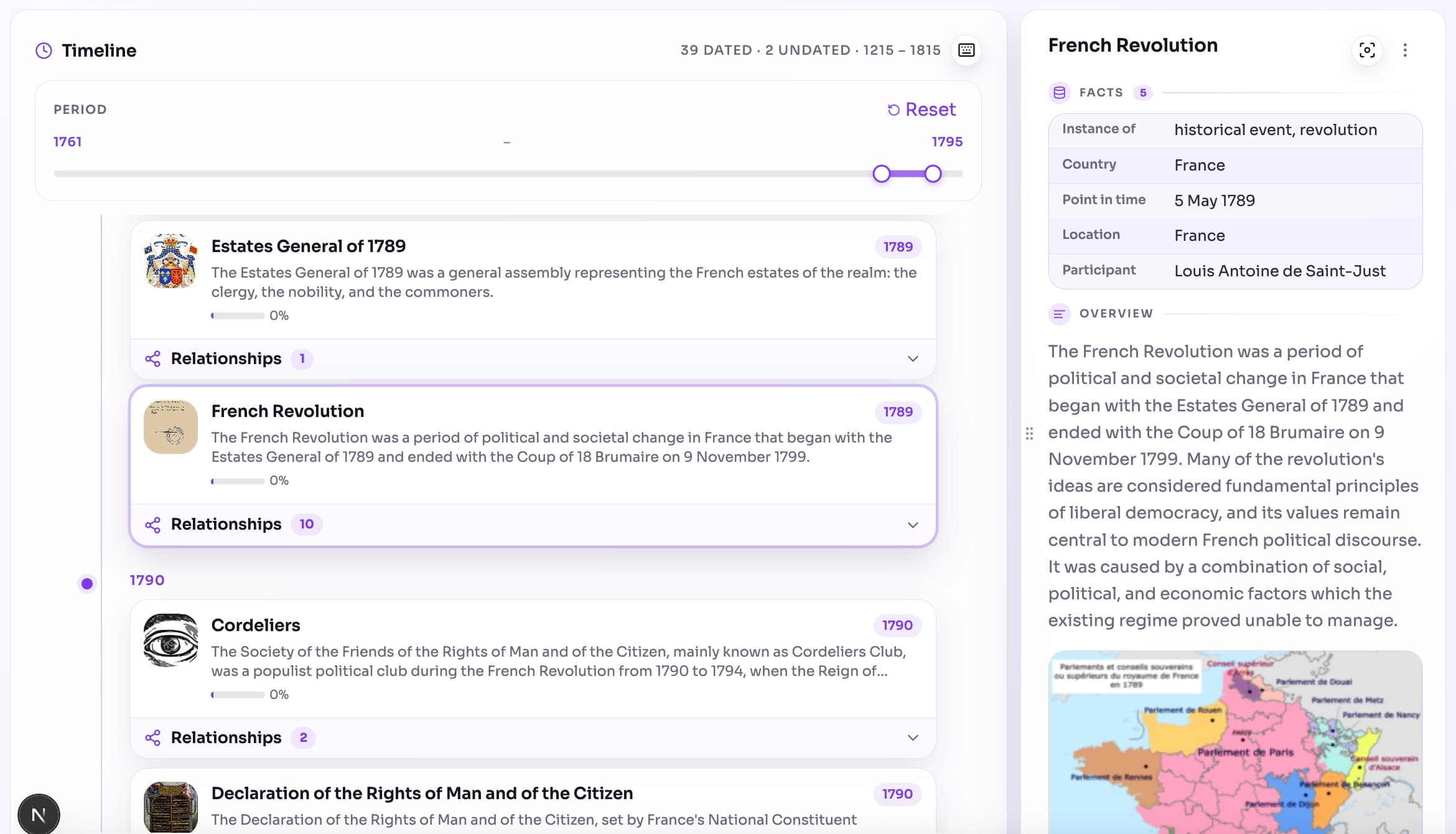
See your discoveries in order
Add dated concepts in Aristotree and view them on a timeline. Keep their sources and connections alongside them.